Ocean Animal Coloring Pages
The ocean covers more than 70% of our planet, so Earth is really more of a water world than a land one. There are five oceans: the Atlantic, Pacific, Indian, Southern and Arctic. They're all joined together, so a sea turtle could swim from one to the next without ever touching land.
Here's something surprising. About half the oxygen we breathe comes from tiny plant-like living things in the ocean called phytoplankton, and they're far too small to see. We also have better maps of the Moon than of the deep ocean floor. That means there are probably creatures down there nobody has ever met!
Ocean Animals A to Z


Crabs
Crabs walk sideways because of the way their legs bend. Scuttling side to side is much quicker for them than moving forward, which makes them very tricky to catch on the beach!
Dolphins
Baby dolphins are born tail first so they don't drown before their first breath. Their mother nudges them straight up to the surface for air, and the two stay close for years after that.
Eels
Many eels start life far out in the ocean as tiny see-through babies. Some swim all the way up rivers and live in ponds for years before heading back out to sea to lay their eggs.
Fish
Fish were swimming around long before the dinosaurs showed up. Some glow in the dark, some puff up like balloons and a few can even climb trees.
Jellyfish
Jellyfish don't have a brain, a heart or any bones. A big group of them is called a smack, which is a pretty funny name for something that drifts along so gently.



Sea Cows
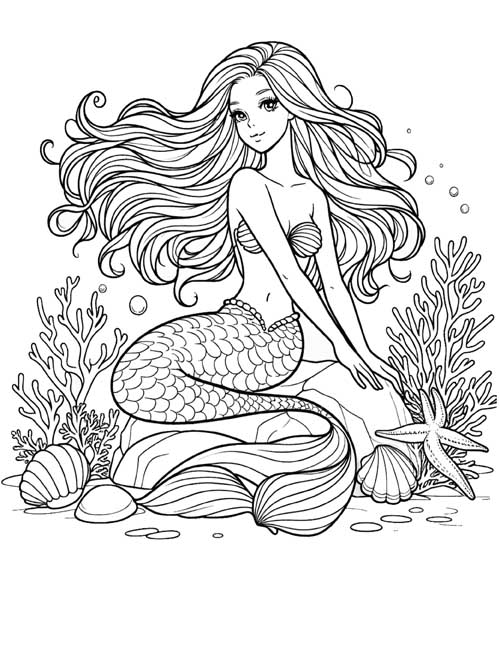
Manatees and dugongs are known as sea cows because they spend their days grazing on seagrass. You can tell them apart by the tail: a manatee has a round paddle, while a dugong has a forked tail like a whale. Long ago, sailors who spotted them from a distance may have mistaken them for mermaids!


Sea Shells
A sand dollar is really a flat sea urchin. The white disks you find on the beach are its empty skeleton, and the star pattern on top has five little petals. Blue mussels hang on to rocks with strong silky threads, so the waves can't wash them away.


Sea Snakes
Sea snakes spend almost their whole lives in the ocean, but they still breathe air and come up to the surface now and then. Their flat, paddle-shaped tails work like oars, which makes them speedy swimmers.
Sea Turtles
Sea turtles spend nearly their whole lives in the water, but the females come ashore to lay their eggs. Many return to the very beach where they hatched, even after swimming thousands of miles.
Seahorses
Seahorses are fish, even though they look like tiny horses. The dad is the one who carries the eggs in a special pouch on his belly, and he's also the one who gives birth to the babies!
Seals
Seals wiggle and flop about on land, but underwater they're graceful swimmers. Fur seals have coats so thick that they stay cosy even in icy Antarctic water.
Seaweed and Seagrass
Seaweed isn't a plant. It's a kind of algae, and it has no roots, just a sticky holdfast that grips the rocks. Eelgrass is different: it's a true flowering plant that grows in meadows on the sea floor, and baby fish hide in it.


Sharks
Sharks never run out of teeth. When one falls out another moves forward to take its place, so a single shark can go through thousands of teeth in its lifetime.
Shrimp


Shrimp swim by flicking their tails, and they can zip backward in a flash if something scary gets close. The common shrimp is hard to spot because it can change its color to match the sandy sea floor.



Walrus
A walrus uses its long tusks like ice picks to haul itself out of the water. Its whiskers are so sensitive that it can find clams buried in the mud without even looking.
Whales
The blue whale is the biggest animal that has ever lived, even bigger than any dinosaur. Its tongue alone can weigh as much as an elephant!
At the Beach
The sand under your toes started out as rocks, shells and coral. Waves spent thousands of years tumbling them about and grinding them down into tiny grains, so every sandcastle is built from a little bit of ocean history.
Marine Mammals
Whales, dolphins and seals live in the sea, but they aren't fish. They breathe air just like we do and have to keep coming up to the surface. Dolphins even sleep with half their brain awake so they remember to take a breath!
Underwater Scenes

Beneath the waves lies a colorful world full of life and motion. Coral reefs, sea plants, and schools of fish create a landscape that feels both peaceful and full of energy. From playful dolphins to mysterious deep-sea creatures, underwater scenes show the beauty and diversity of life beneath the surface.

