Rhinoceros Coloring Pages
Welcome to my Rhinoceros coloring pages section.
The word rhinoceros comes from Greek and means "nose horn". Five kinds of rhino still live in the wild, two in Africa and three in Asia, and the Javan and Sumatran rhinos are so rare that fewer than a hundred of them are left.
Jump to: Simple | Babies | Cartoon | Realistic | Dürer | Zentangle and Floral | Species | Fun Facts
Simple Rhino Coloring Pages
Rhinos can't see very far, but their hearing and sense of smell are excellent, and they can swivel each ear on its own to catch sounds from every direction. It's a bit like having two tiny satellite dishes on top of your head.


Baby Rhinos
A baby rhino is called a calf, and it starts out without a horn. It stays close to its mum for two or three years, and the horn grows in later.


Cartoon Rhinos Out and About
Rhinos love to wallow in mud, and it isn't just for fun. A thick coat of mud works like sunscreen and bug spray for their skin.


Realistic Rhino Coloring Pages
A rhino's horn has no bone inside. It's made of keratin that keeps growing from the skin throughout the rhino's life, a bit like a fingernail.


Dürer's Famous Rhinoceros
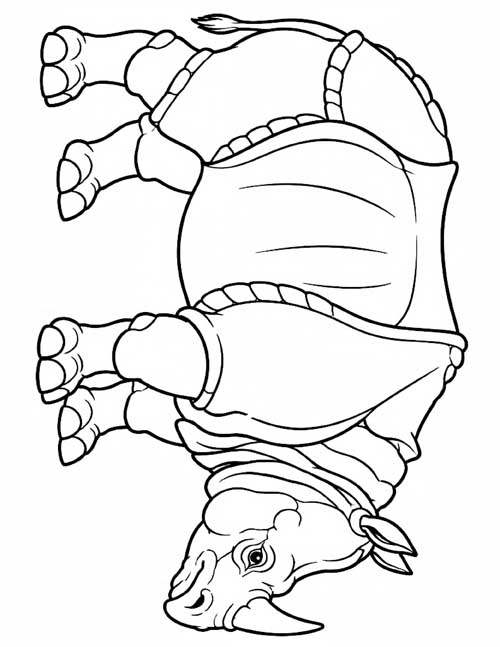
In 1515 a rhino sailed from India to Portugal, and a German artist named Albrecht Dürer drew it without ever seeing it, using only a sketch and a description. That's why his rhino looks like it's dressed in armour, and his picture was copied in books for hundreds of years.
Zentangle and Floral Rhinos
Zentangle art builds a picture out of repeating patterns, one small stroke at a time, and a rhino's folded skin is a good place to start.


The Five Kinds of Rhinoceros
White Rhinoceros (Ceratotherium simum)
The white rhinoceros is the biggest rhino of all, and it has a wide, square mouth made for grazing on grass. About 15,700 are left in the savannas and grasslands of southern and eastern Africa.
Black Rhinoceros (Diceros bicornis)
The black rhinoceros is a little smaller and has a pointed, hooked upper lip that grabs leaves and twigs from bushes. About 6,800 live in the savannas and shrublands of eastern and southern Africa, and their numbers are slowly growing.
Indian Rhinoceros (Rhinoceros unicornis)
The Indian rhinoceros has just one horn and folds of skin that look like plates of armour. About 4,000 live in the grasslands and swamps of northern India and Nepal.
Javan Rhinoceros (Rhinoceros sondaicus)
The Javan rhinoceros is the rarest rhino, with only about 50 left. Javan rhinos once lived across Southeast Asia, and now the last small group lives in one place, Ujung Kulon National Park on the island of Java in Indonesia.
Sumatran Rhinoceros (Dicerorhinus sumatrensis)
The Sumatran rhinoceros is the smallest rhino and the only one covered in shaggy reddish-brown hair, which fits, because it's the closest living relative of the woolly rhinoceros from the Ice Age. Fewer than 50 are left in the rainforests of Indonesia, mostly on the island of Sumatra.
All five kinds of rhino are threatened. Poachers hunt them for their horns, and losing their homes to farms and towns is a problem too. Rangers and conservation groups work hard to protect the rhinos that are left, and some groups, like the black rhinos, are slowly growing again.
5 Fun Facts About Rhinoceroses
- The white rhinoceros is one of the heaviest land animals alive and can weigh up to 2,300 kilograms (5,000 pounds), about as much as a small car.
- A rhino's skin can be up to 5 centimetres (2 inches) thick and folds like armour plates, but it's still sensitive to sunburn and insect bites.
- A group of rhinos is called a crash.
- Even at that size, a rhino can charge at around 50 kilometres per hour (30 miles per hour).
- Rhinos are relatives of horses and tapirs, and they have three toes on each foot.